How many of us uses Adobe Photoshop to edit the creases and pimples in our face? I'd say a good 5 out of 10 people. But what if the pictures you get in newspapers had been edited to make you believe things they want you to believe? http://abcnews.go.com/blogs/headlines/2011/12/north-korea-restores-order-to-kim-funeral-with-photoshop/ displays an article that talks about how the North Korean Central News Agency had sent a edited picture using Photoshop to a Germany-based European pressphoto agency. This picture was captured during the procession of the late Kim-Jong Il but as one can see below, several men were literally cropped out of the picture.
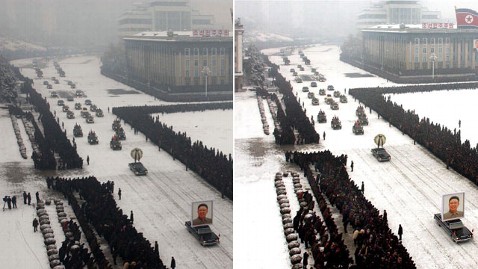
As the media, I dont think it is right for a newspaper to do that as the role of the media is to report the truth and not alter the fact. This crosses the boundaries of photojounalism ethics. According to Mitchell (2000), the camera is an extension of a journalist when it becomes a commentator which can comments through its images, it can interpret the scenario and it can picture the world as how the journalist wants it to. Therefore, a picture from a journalist holds quite some power in the media. It tells how a scenario went down. Yung & Kelly (2008) states that although journalist have objective reporting in mind, the subjective influence of media personnel, and media organization is always present. It could be possible that the journalist from the Korean Agency had wanted the picture out the way it was taken but knowing how Korea is a authoritative country whereby order is prime, wanted the side people out of the photo as it does not show the lines being proper. Moreover, the accountability of the news agency is questions as according to Laitila (1995) the function of journalism ethics is to very first address the accountability to the interested parties mainly the state, the public, the sources and the advertisers. The accountability of the Korean News Agency is definitely tarnish as the public are starting to question if that picture is the only picture that had been edited before being published by various other media.
Thus, editing a picture within a newspaper does not comply with the national jounalism ethics which is to report the truth.
References
Mitchell, J 2000, 'The ethics of photojounalism', Studies in Christian Ethics, vol. 13, no. 1, pp. 1 - 16, viewed 3 June 2012, <http://sce.sagepub.com.ezlibproxy.unisa.edu.au/content/13/1/1.full.pdf+html>
Yung, S.K, Kelly, J.D 2008, 'A matter of culture : a comparative study of photojournalism in american and korean newspaper', International Communication Gazzette, vol. 70, no. 2, pp. 155 - 173, viewed 3 June 2012, <http://gaz.sagepub.com.ezlibproxy.unisa.edu.au/content/70/2/155.full.pdf+html>
Laitila, T 1995, 'Journalistic codes of ethics in Europe', European Journal of Communication, vol. 10, no. 4, pp. 527 - 544, viewed 3 June 2012, <http://ejc.sagepub.com.ezlibproxy.unisa.edu.au/content/10/4/527.full.pdf+html>

No comments:
Post a Comment