Reflection
Blogging has gain its recognition as a worldwide phenomenon that has taken everyone by storm. There are challenges to blogging and starting out as a beginner blogger is not easy. Zúñiga et.al (2011) agrees that as bloggers mature into the blogging world, one starts to understand the functions and the power of blogging. Writing for a blog is different from writing for a magazine or a newspaper. A blog does not comply to certain writing guides that magazines or newspapers have to follow. Casual language is allowed to be used writing for a blog. Jargons, and the use of 'I' to refer to the first person can be used because the ones who would be reading the blog would be those from the same community and society. Hence, the shared norms of communicating. To conclude, bloggers have it easy compared to those writing for a more professional published materials.
References
Zúñiga, H.G.D, Lewis, S.C, Willard, A, Valenzuala, S, Lee, J.K 2011, 'Blogging as a journalistic practice: A model linking perception, motivation, and behavior', Journalism, vol. 12, no. 5, pp. 586 - 606, viewed 4 June 2012, <http://jou.sagepub.com.ezlibproxy.unisa.edu.au/content/12/5/586.full.pdf+html>
Sunday, June 3, 2012

Sex and ... no just sex!
It is amazing how good and effective advertisers uses sex to sell us something that we don't need whether it be underwear, lingerie, fragrance, and clothing. An article http://www.dailylife.com.au/dl-beauty/the-highly-sexual-art-of-selling-perfume-20120518-1yvd4.html by Daily Life writes about females being portrayed in a sexual way almost submissive in advertisements that tries its very best to sell to the public a fragrance they don't need. What can be question is that if advertisers are already making fragrance ads look like soft-core porn, what would be the future of advertisements?
According to Gill (2009), this sexualization culture is turning into a 'pornified' culture whereby women and men are portrayed in a sexual way in advertisements. A Calvin Klein ad of its new perfume uses Eva Mendes as its spokesperson where Mendes is seen naked on the bed and half of her breast is shown to the camera. That would be a very good example of how advertisements are turning into pornographic business. The phrase 'Sex sells' is taken to a literal meaning by advertisers. This point of view is supported by Lazar (2009) when she writes that traditional media portrays women in a narrow, stereotypical passive and as a sexual object. Products as diverse as transmissions, after-shave lotion, liquor and hair dryers, to name a few,are being promoted by female models in various states of undress. (Reidenbach & McCleary, 1983) It is uncertain when did the sexualization of women began but it is widely used worldwide. Most advertisements, if observed, the camera becomes the male gaze
whereby the camera is position in a way how a male would see a female. Moreover, the reason why this has continued because is it actually effective on both sexes. Males would buy that fragrance because they like the model in the ad or a present to the girlfriend or wife. Females, on the other hand, has the desire to be the models in those ads as that is the most effective way to attract a male counterpart.
To conclude, it is important to note the power of sexualization that is highly effective but it is good to understand the fine line between a classy advertisement or pornographic advertisement.
References
Gill, R 2009, 'Beyond the ‘Sexualization of culture’ thesis: an intersectional analysis of ‘sixpacks’,‘midriffs’ and ‘hot lesbians’ in advertising', Sexualities, vol. 12, no. 2, pp. 137 - 160, viewed 3 June 2012, <http://sex.sagepub.com.ezlibproxy.unisa.edu.au/content/12/2/137.full.pdf+html>
Lazar, M.M 2009, 'Entitled to consume: postfeminist femininity and a culture of post-critique', Discourse & Communication, vol. 3, no. 4, pp. 371 - 400, viewed 3 June 2012,<http://dcm.sagepub.com.ezlibproxy.unisa.edu.au/content/3/4/371.full.pdf+html>
Reidenbach, R.E, McCleary, K.W 1983, 'Advertising and male nudity: an experimental investigation', Journal of the Academy of Marketing Science, vol. 11, no. 4, pp. 444 - 454, viewed 3 June 2012, <http://jam.sagepub.com.ezlibproxy.unisa.edu.au/content/11/4/444.full.pdf+html>
It is amazing how good and effective advertisers uses sex to sell us something that we don't need whether it be underwear, lingerie, fragrance, and clothing. An article http://www.dailylife.com.au/dl-beauty/the-highly-sexual-art-of-selling-perfume-20120518-1yvd4.html by Daily Life writes about females being portrayed in a sexual way almost submissive in advertisements that tries its very best to sell to the public a fragrance they don't need. What can be question is that if advertisers are already making fragrance ads look like soft-core porn, what would be the future of advertisements?
According to Gill (2009), this sexualization culture is turning into a 'pornified' culture whereby women and men are portrayed in a sexual way in advertisements. A Calvin Klein ad of its new perfume uses Eva Mendes as its spokesperson where Mendes is seen naked on the bed and half of her breast is shown to the camera. That would be a very good example of how advertisements are turning into pornographic business. The phrase 'Sex sells' is taken to a literal meaning by advertisers. This point of view is supported by Lazar (2009) when she writes that traditional media portrays women in a narrow, stereotypical passive and as a sexual object. Products as diverse as transmissions, after-shave lotion, liquor and hair dryers, to name a few,are being promoted by female models in various states of undress. (Reidenbach & McCleary, 1983) It is uncertain when did the sexualization of women began but it is widely used worldwide. Most advertisements, if observed, the camera becomes the male gaze
whereby the camera is position in a way how a male would see a female. Moreover, the reason why this has continued because is it actually effective on both sexes. Males would buy that fragrance because they like the model in the ad or a present to the girlfriend or wife. Females, on the other hand, has the desire to be the models in those ads as that is the most effective way to attract a male counterpart.
To conclude, it is important to note the power of sexualization that is highly effective but it is good to understand the fine line between a classy advertisement or pornographic advertisement.
References
Gill, R 2009, 'Beyond the ‘Sexualization of culture’ thesis: an intersectional analysis of ‘sixpacks’,‘midriffs’ and ‘hot lesbians’ in advertising', Sexualities, vol. 12, no. 2, pp. 137 - 160, viewed 3 June 2012, <http://sex.sagepub.com.ezlibproxy.unisa.edu.au/content/12/2/137.full.pdf+html>
Lazar, M.M 2009, 'Entitled to consume: postfeminist femininity and a culture of post-critique', Discourse & Communication, vol. 3, no. 4, pp. 371 - 400, viewed 3 June 2012,<http://dcm.sagepub.com.ezlibproxy.unisa.edu.au/content/3/4/371.full.pdf+html>
Reidenbach, R.E, McCleary, K.W 1983, 'Advertising and male nudity: an experimental investigation', Journal of the Academy of Marketing Science, vol. 11, no. 4, pp. 444 - 454, viewed 3 June 2012, <http://jam.sagepub.com.ezlibproxy.unisa.edu.au/content/11/4/444.full.pdf+html>
Saturday, June 2, 2012
Photo-shocked
How many of us uses Adobe Photoshop to edit the creases and pimples in our face? I'd say a good 5 out of 10 people. But what if the pictures you get in newspapers had been edited to make you believe things they want you to believe? http://abcnews.go.com/blogs/headlines/2011/12/north-korea-restores-order-to-kim-funeral-with-photoshop/ displays an article that talks about how the North Korean Central News Agency had sent a edited picture using Photoshop to a Germany-based European pressphoto agency. This picture was captured during the procession of the late Kim-Jong Il but as one can see below, several men were literally cropped out of the picture.

How many of us uses Adobe Photoshop to edit the creases and pimples in our face? I'd say a good 5 out of 10 people. But what if the pictures you get in newspapers had been edited to make you believe things they want you to believe? http://abcnews.go.com/blogs/headlines/2011/12/north-korea-restores-order-to-kim-funeral-with-photoshop/ displays an article that talks about how the North Korean Central News Agency had sent a edited picture using Photoshop to a Germany-based European pressphoto agency. This picture was captured during the procession of the late Kim-Jong Il but as one can see below, several men were literally cropped out of the picture.
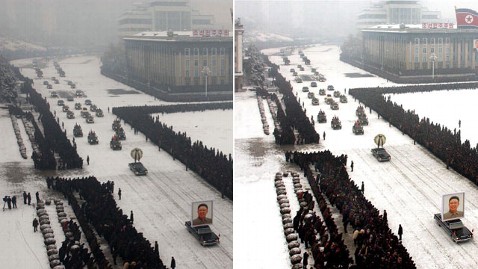
As the media, I dont think it is right for a newspaper to do that as the role of the media is to report the truth and not alter the fact. This crosses the boundaries of photojounalism ethics. According to Mitchell (2000), the camera is an extension of a journalist when it becomes a commentator which can comments through its images, it can interpret the scenario and it can picture the world as how the journalist wants it to. Therefore, a picture from a journalist holds quite some power in the media. It tells how a scenario went down. Yung & Kelly (2008) states that although journalist have objective reporting in mind, the subjective influence of media personnel, and media organization is always present. It could be possible that the journalist from the Korean Agency had wanted the picture out the way it was taken but knowing how Korea is a authoritative country whereby order is prime, wanted the side people out of the photo as it does not show the lines being proper. Moreover, the accountability of the news agency is questions as according to Laitila (1995) the function of journalism ethics is to very first address the accountability to the interested parties mainly the state, the public, the sources and the advertisers. The accountability of the Korean News Agency is definitely tarnish as the public are starting to question if that picture is the only picture that had been edited before being published by various other media.
Thus, editing a picture within a newspaper does not comply with the national jounalism ethics which is to report the truth.
References
Mitchell, J 2000, 'The ethics of photojounalism', Studies in Christian Ethics, vol. 13, no. 1, pp. 1 - 16, viewed 3 June 2012, <http://sce.sagepub.com.ezlibproxy.unisa.edu.au/content/13/1/1.full.pdf+html>
Yung, S.K, Kelly, J.D 2008, 'A matter of culture : a comparative study of photojournalism in american and korean newspaper', International Communication Gazzette, vol. 70, no. 2, pp. 155 - 173, viewed 3 June 2012, <http://gaz.sagepub.com.ezlibproxy.unisa.edu.au/content/70/2/155.full.pdf+html>
Laitila, T 1995, 'Journalistic codes of ethics in Europe', European Journal of Communication, vol. 10, no. 4, pp. 527 - 544, viewed 3 June 2012, <http://ejc.sagepub.com.ezlibproxy.unisa.edu.au/content/10/4/527.full.pdf+html>
Culture shock?
As a multi-racial country living harmoniously among each other, Malaysia sure knows how to prioritize its Muslim religion to protect themselves well. The article http://www.kwongwah.com.my/news/2011/08/17/109.html talks about how the Home minister Datuk Seri Hishammuddin Tun Hussein had rebuke The Star newspaper over their spread on the different places of food that the public can go during the puasa month. The Star had recommended a restaurant that serves the best pork ribs in town which does not comply with the Muslim faith as according to Fonte & Horton-Deutsch (2005) Muslims aren't allowed to drink alcoholic beverage and eat pork as it is deemed as non-halal. Thus, The Star will publicly apologize for its mistake. What interest me is that, does it mean that just because its the puasa month that the other races be neglected?
Even so Malaysia's a Muslim country but it is also a democratic state whereby the Constitution of Malaysia states that Islam is the religion of the Federation; but other religions may be practised in peace and harmony in any part of the Federation. So, why must The Star be reprimanded for only posting one restaurant that serves pork? According to Rostbøll (2011), the freedom of expression is understood as freedom to express oneself within certain restrictions that is seen necessary. I do believe that The Star was trying to cater to everyone's needs as Muslims are not the only ones who reads the daily paper. However, what I do agree about is that perhaps the title of the spread should have change from 'Ramadhan Delights' to its original name 'Dining-out'. It would seem more appropriate. Nevertheless, it is a mistake that The Star had to be held for because of its neglect on small details but it was definitely overly taken a back by the Government. It was a story that should not have blown up to the scale that it was.
In a nut shell, tolerance is key in maintaining harmony within a country. The Star admits that it is their fault for committing a mistake but the Government could have lessen the critiques that The Star editors had to take.
References
Fonte, J, Horton-Deutsch, S 2005, 'Treating postpartum depression in immigrant muslim women', Journal of the American Psychiatric Nurses Association, vol. 11, no. 1, pp. 39 - 44, viewed 2 June 2012, <http://jap.sagepub.com.ezlibproxy.unisa.edu.au/content/11/1/39.full.pdf+html>
Constitution of Malaysia (Cmwth)
Rostbøll, C.F 2011, 'Freedom of expression, deliberation, autonomy and respect', European Journal of Political Theory, vol. 10, no. 1, pp. 5 - 21, viewed 2 June 2012, <http://ept.sagepub.com.ezlibproxy.unisa.edu.au/content/10/1/5.full.pdf+html>
As a multi-racial country living harmoniously among each other, Malaysia sure knows how to prioritize its Muslim religion to protect themselves well. The article http://www.kwongwah.com.my/news/2011/08/17/109.html talks about how the Home minister Datuk Seri Hishammuddin Tun Hussein had rebuke The Star newspaper over their spread on the different places of food that the public can go during the puasa month. The Star had recommended a restaurant that serves the best pork ribs in town which does not comply with the Muslim faith as according to Fonte & Horton-Deutsch (2005) Muslims aren't allowed to drink alcoholic beverage and eat pork as it is deemed as non-halal. Thus, The Star will publicly apologize for its mistake. What interest me is that, does it mean that just because its the puasa month that the other races be neglected?
Even so Malaysia's a Muslim country but it is also a democratic state whereby the Constitution of Malaysia states that Islam is the religion of the Federation; but other religions may be practised in peace and harmony in any part of the Federation. So, why must The Star be reprimanded for only posting one restaurant that serves pork? According to Rostbøll (2011), the freedom of expression is understood as freedom to express oneself within certain restrictions that is seen necessary. I do believe that The Star was trying to cater to everyone's needs as Muslims are not the only ones who reads the daily paper. However, what I do agree about is that perhaps the title of the spread should have change from 'Ramadhan Delights' to its original name 'Dining-out'. It would seem more appropriate. Nevertheless, it is a mistake that The Star had to be held for because of its neglect on small details but it was definitely overly taken a back by the Government. It was a story that should not have blown up to the scale that it was.
In a nut shell, tolerance is key in maintaining harmony within a country. The Star admits that it is their fault for committing a mistake but the Government could have lessen the critiques that The Star editors had to take.
References
Fonte, J, Horton-Deutsch, S 2005, 'Treating postpartum depression in immigrant muslim women', Journal of the American Psychiatric Nurses Association, vol. 11, no. 1, pp. 39 - 44, viewed 2 June 2012, <http://jap.sagepub.com.ezlibproxy.unisa.edu.au/content/11/1/39.full.pdf+html>
Constitution of Malaysia (Cmwth)
Rostbøll, C.F 2011, 'Freedom of expression, deliberation, autonomy and respect', European Journal of Political Theory, vol. 10, no. 1, pp. 5 - 21, viewed 2 June 2012, <http://ept.sagepub.com.ezlibproxy.unisa.edu.au/content/10/1/5.full.pdf+html>
Friday, June 1, 2012
Censorship in Malaysia has taken itself to an extreme whereby almost anything that is not in the favour of the Government would see itself charged through the various censorship laws available for their use. The article http://www.bbc.co.uk/news/uk-17112635, talks about a book titled 'Where did I come from?' written by Peter Mayle that is banned by the Malaysian government for being explicitly talking about sex. The children's book that is to help parents educate their young children about sex and contraception is said to be too visually explicit by the Malaysian Government. If the book was really banned, a fine up to RM 20, 000 could be implied upon any who distributes or sells the book based on the Printing Presses and Publication Act of 1984.
In my opinion, the question of what should or should not be censored comes to mind. According to Lent (1974), Malaysia's press is controlled by the legislations and ownerships of media which. This leads to the passing of the Printing Presses and Publication Act of 1984 that has strict regulations on the print media.
The Printing Presses and Publication Act 1984 states that any publication that is to produce materials that are obscene or otherwise against public decency shall be guilty to a fine of up to RM20, 000 or no more than three years jail sentence. What is interesting is that, the moral responsibility of parents to educate their young about sex and contraception is in a knot with the legislation at hand. Cornwell & Welbourn, 2000 cited in Izugbara 2007, states that sex education within a home is necessary for children to get accurate and adequate information. Therefore, parents either use other mediums to teach their children on sex or they shy away from the topic.
To conclude, censorship holds a strong power in Malaysia as it determines what is fed to the public. The role of media to inform is now controlled by what the Government wants to inform the public about.
References
Lent J.A 1974, 'Malaysia's guided media', Index on Censorship, vol. 3, no. 4, pp. 65 - 75, viewed 1 June 2012, <http://ioc.sagepub.com.ezlibproxy.unisa.edu.au/content/3/4/65.full.pdf+html>
Printing Presses and Publication Act 1984 (Cwlth)
Izugbara, C.O 2007, 'Home-based sexuality education : nigerian parents discussing sex with their children', Youth & Society, vol. 39, no. 4, pp. 575 - 600, viewed 1 June 2012, <http://yas.sagepub.com.ezlibproxy.unisa.edu.au/content/39/4/575.full.pdf+html>
In my opinion, the question of what should or should not be censored comes to mind. According to Lent (1974), Malaysia's press is controlled by the legislations and ownerships of media which. This leads to the passing of the Printing Presses and Publication Act of 1984 that has strict regulations on the print media.
The Printing Presses and Publication Act 1984 states that any publication that is to produce materials that are obscene or otherwise against public decency shall be guilty to a fine of up to RM20, 000 or no more than three years jail sentence. What is interesting is that, the moral responsibility of parents to educate their young about sex and contraception is in a knot with the legislation at hand. Cornwell & Welbourn, 2000 cited in Izugbara 2007, states that sex education within a home is necessary for children to get accurate and adequate information. Therefore, parents either use other mediums to teach their children on sex or they shy away from the topic.
To conclude, censorship holds a strong power in Malaysia as it determines what is fed to the public. The role of media to inform is now controlled by what the Government wants to inform the public about.
References
Lent J.A 1974, 'Malaysia's guided media', Index on Censorship, vol. 3, no. 4, pp. 65 - 75, viewed 1 June 2012, <http://ioc.sagepub.com.ezlibproxy.unisa.edu.au/content/3/4/65.full.pdf+html>
Printing Presses and Publication Act 1984 (Cwlth)
Izugbara, C.O 2007, 'Home-based sexuality education : nigerian parents discussing sex with their children', Youth & Society, vol. 39, no. 4, pp. 575 - 600, viewed 1 June 2012, <http://yas.sagepub.com.ezlibproxy.unisa.edu.au/content/39/4/575.full.pdf+html>
Subscribe to:
Posts (Atom)